There are now new additional details and ample conceptual visuals of the ambitious project to build a highly transformative city-building redevelopment in the Central Business District of downtown Vancouver.
As reported by Daily Hive Urbanized in May 2025, local developer Holborn Group and architectural firm Henriquez Partners Architects have submitted a rezoning application to the municipal government to pursue a landmark redevelopment of the Hudson’s Bay parkade city block at 501-595 West Georgia St., situated at the northeast corner of the intersection of Seymour Street and West Georgia Street.
And now, today, the full rezoning application files for each of the three development sites of the project have been made public to kick off the City of Vancouver’s formal public consultation process for the project.
The redevelopment of the Bay parkade has been split up into two applications — west and eastern halves, fronting Seymour Street and Richards Street, respectively. The third application is for 388 Abbott St., located a few city blocks to the northeast at the southern edge of Gastown, where Holborn Group intends to build a 38-storey, mixed-use social housing tower as a gift to the municipal government in exchange for enabling the high-density market residential and commercial uses on the Bay parkade site.
Big changes to the skyline
The Bay parkade redevelopment involves building three major mixed-use towers.
On the Seymour Street side of the parkade block, there will be a 1,034-ft-tall (315 metres), 68-storey hotel tower with an observation deck attraction, making it not only Western Canada’s new tallest building but also this part of the country’s first “supertall” building — defined as a skyscraper that reaches at least 984 ft. (300 metres).
On the Richards Street side of this same block, there will be two mixed-use condominium, rental housing, and commercial towers, reaching 889 ft. (271 metres) with 79 storeys and 783 ft. (239 metres) with 68 storeys. If both of these towers existed today, they would be the tallest buildings within Vancouver by a wide margin and rival the heights of future tall towers planned for Burnaby and Surrey.
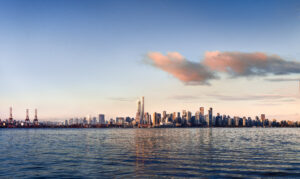
Visible from across Metro Vancouver, these three towers would form a new urban pinnacle in downtown Vancouver, contributing greatly to the municipal government’s longstanding concept of shaping a dome-shaped skyline.
Furthermore, the location lends itself to high-density uses for not only being in the core of the city centre, but also its adjacency to SkyTrain’s Granville Station, with the project promising to build a new additional direct street entrance into the station from near the northeast corner of the intersection of West Georgia Street and Seymour Street. It is also in close proximity to SkyTrain’s Vancouver City Centre Station and various other public transit services.
“The towers would be located in the centre of the retail and business district, forming the peak of the dome that defines the city’s skyline. In Vancouver, as the centre of the Metro area as well as Western Canada, it would be appropriate to have density and height that aligns with its regional and global stature,” reads the project’s design rationale.
“Located adjacent to one of the key intersections in the city at West Georgia and Granville Streets, the project has the potential to be a significant marker in the downtown core. The expansion of the City’s cultural and sport venues to the east along West Georgia further emphasizes the centrality of the site and the opportunity to define it architecturally in the tradition of major cities around the world.”
A world-class observation deck attraction atop the hotel skyscraper
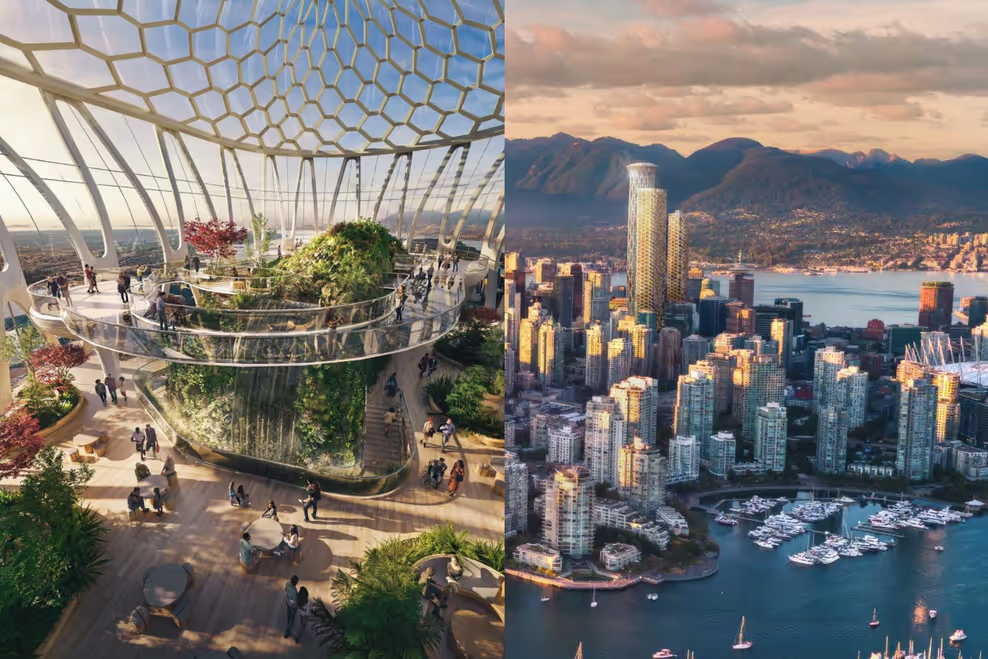
The supertall hotel tower will boast an expansive world-class observation deck attraction on its uppermost levels, concealed within a jewel-like glass dome with multiple levels. Perched at an elevation of over 1,000 ft. (305 metres), this attraction will provide unobstructed, far-reaching views of Metro Vancouver, Burrard Inlet, the mountains, and points beyond.
The observation attraction will be akin to a garden — conceived as “a conservatory with a variety of plants throughout the interior spaces,” and even featuring a waterfall. There will be a restaurant, a lounge, various seating areas, a tree-top walk, and event space. Out-of-town visitors will pay an admission fee, while Vancouver residents will be able to enjoy this destination for free.
Not including Toronto’s CN Tower, which is technically deemed to be a “structure,” not a “building,” this supertall tower would boast the title of being Canada’s tallest building with a public observation deck.
The dome enclosure will be an organic-like grid of skylights with embedded photovoltaics.
To access the observation attraction, two high-speed, non-stop, direct elevators will take guests from the tower’s second level, which is entirely dedicated as a lobby and welcome area for the major attraction. The street-level entrance into the attraction will be situated mid-block on Seymour Street.
Altogether, a substantial 53,000 sq. ft. of total building floor area is dedicated to the observation attraction.
On the 65th level, just below the observation attraction, there will be a tuned mass damper to minimize the tower’s movement due to high wind and seismic events. Such dampers exist on many tall towers worldwide — especially those that have a narrow width — and one such local example is the damper atop downtown Vancouver’s Sheraton One Wall Centre tower, which uses a liquid-tuned mass damper.
The wide range of different uses in this tower necessitates a creative, yet also efficient, elevator system. Altogether, there will be 24 elevators within the core of the tower that travel a partial or full height of the building.
Between the 31st and 64th floors of the supertall hotel tower, there will be 680 traditional short-term stay hotel guest rooms. The short-term stay hotel’s lobby will be on the 28th level, with short-term guests taking express elevators from the ground level to the 28th level to transfer to local elevators that reach their hotel suite within the upper half of the tower.
Just below, between the 11th and 25th floors, will be the long-term stay hotel, which will have its lobby located on the 26th level.
There will be a total of 920 hotel guest rooms — 680 short-term stay and 240 long-term stay — to make this B.C.’s largest hotel in terms of room capacity. This will make a real dent in narrowing the gap of the City of Vancouver’s projected shortage of 10,000 hotel rooms over the coming decades.
Hotel guests will have access to various indoor and outdoor amenity facilities located throughout the tower, including an indoor swimming pool and hot tub, as well as an outdoor amenity deck on the rooftop of the base podium.
Various conference and meeting spaces totalling over 70,000 sq. ft. will be found between the third and eighth levels and on the 10th level. This includes three high-ceiling ballrooms stacked on top of each other within the tower’s base podium. Altogether, this will be one of B.C.’s largest hotel conference centres.
The entire ground level is dedicated to a main hotel lobby and hotel bar/cafe with ample seating.
New SkyTrain station entrance, restaurant and retail space, plaza, and residential towers
Just outside the main entrance into the hotel is a striking two-storey restaurant pavilion building — complete with space for outdoor patios — and a 17,000 sq. ft. privately-owned public plaza, all situated at the northeast corner of the intersection of Seymour Street and West Georgia Street.
The additional street entrance into Granville Station will be fully integrated into this restaurant pavilion building, with this entrance served by a down escalator and an up escalator. An underground passageway beneath Seymour Street will be built to reach an expanded station concourse level beneath the former Hudson’s Bay department store building.
The plaza — featuring high-quality pavers, playful water features, seating, some landscaping, and event-friendly design configurations — also doubles as a mid-block pedestrian connection across the city block, between the three towers.
As for the two comparatively shorter towers on the east side of the Bay parkade city block, fronting Richards Street, there will be 1,561 homes, including 1,288 strata market ownership condominium homes and 273 secured purpose-built market rental homes. The overall unit size mix is 968 one-bedroom units, 392 two-bedroom units, and 201 three-bedroom units.
Residents will have access to ample shared indoor and outdoor amenity spaces within the lower floors of the building, including an expansive outdoor amenity space on the rooftop of the shared base podium between both mixed-use residential towers. This base podium’s ground level will provide about 40,000 sq. ft. of retail/restaurant space, serving to activate the plaza and street frontages.
The overall architectural concept of the Bay parkade redevelopment takes inspiration from the B.C. coast, with the supertall tower mimicking the exoskeleton structure of a glass sponge coral. The tower is supported by a diagrid exoskeleton seen on its facade, which reduces the use of internal columns to enable more efficient floor plate layouts and ultimately more hotel guest rooms.
The restaurant pavilion building and the two mixed-use residential towers also feature different coral-like architectural features, while the base podium is similarly inspired by coral reefs and underwater habitats. The plaza itself takes inspiration from erosion of the shoreline and rock formations from wave action over time.
The brick facade of the heritage Randall building at 555 West Georgia St. will be retained and integrated into the base podium of the mixed-use residential towers, providing contrast with the organic contemporary design. The small office building at 570 Dunsmuir St. is not part of the project and will be retained.
The heritage preservation, base podium, and plaza designs will also take into account Indigenous design considerations.
As for vehicle parking, the hotel tower side of the complex will have seven underground levels, including hotel back-of-house facilities and parking ramps on P1, the dedicated hotel pick-up and drop-off area for vehicles and a portion of the Granville Station expansion on P2, and truck loading and additional hotel back-of-house facilities on P3. Approximately 450 vehicle parking stalls will be found between P4 and P7.
Beneath the mixed-use residential towers, there will be nine underground levels, containing 870 vehicle parking stalls — including 687 stalls for residential/general purpose, 54 stalls for residential accessible, 78 stalls for residential visitor, and 51 stalls for non-residential. Additionally, over 3,200 secured bike parking spaces will be provided to residents.
In total, the entire three-tower complex on the Bay parkade site will generate a combined total of 1,320 vehicle parking stalls. This includes the developer’s legal requirement to provide 500 replacement public parking stalls, based on a decades-old previous agreement made with the property owner of the Hudson’s Bay department store property — effectively serving to replace the existing parkade’s capacity.
The supertall hotel tower will have a total building floor area of 1.231 million sq. ft., establishing a floor area ratio (FAR) density that is 24.1 times larger than the size of the western half of the parkade site.
The mixed-use residential towers will have a total building floor area of 1.878 million sq. ft., which provides it with a FAR density of 31.3.
Combined, the entire three-tower complex will have a total building floor area of over 3.1 million sq. ft on a 2.54-acre footprint.
These will be some of the largest buildings in B.C., not just for their height but also for the total building floor area. By contrast, the nearby The Post complex — anchored by Amazon’s corporate offices — is 1.3 million sq. ft., and the original four office towers of Bentall Centre have a combined size of 1.5 million sq. ft.
This substantial project will still strive to meet a high degree of environmental excellence, such as the inclusion of an on-site central energy plant, enhanced sustainability features to achieve net-zero carbon operational, and achieve 50 per cent below the City of Vancouver’s Low Carbon Energy targets.
Gastown social housing tower gift to the City
As for the new social housing tower at the Gastown site — situated at the northeast corner of the intersection of West Hastings Street and Abbott Street, immediately east of the Woodward’s complex — this will be a 402-ft-tall (123 metres), 38-storey, mixed-use tower with 378 social housing units, a 6,900 sq. ft. childcare facility for 37 kids, and a 5,100 sq. ft. Indigenous art gallery space.
The entire building will be built to a turnkey condition, and then gifted to the City as a substantial community amenity contribution associated with the Bay parkade redevelopment. Currently, the 13,000 sq. ft. site is used as a surface vehicle parking lot.
This Gastown building will have a total building floor area of 317,000 sq. ft., establishing a floor area ratio density of a floor area that is 24.4 times larger than the size of the lot. Just 38 vehicle parking stalls, but over 800 secured bike parking spaces will be provided.
The mixed-use condominium towers on the main project site and the social housing tower on the Gastown site would be built at the same time — together, as the project’s first phase. It is anticipated that the City will require the developer to build the mixed-use condominium and social housing towers simultaneously.
If all goes according to plan — including successful pre-sales toward the end of this decade — construction on the first phase could begin around 2030. This phase is expected to take approximately four years to build, with construction on the supertall hotel tower also commencing at some point during this period. The full buildout of the entire development is projected to span 13 to 15 years, placing potential completion in the late 2030s at the earliest.
As is, the estimated total construction cost of this four-tower project across two separate sites is about $2.73 billion, including the gift to the City of a $224-million, mixed-use social housing tower.